
While hypertension is a significant healthcare challenge, affecting nearly 48% of the United States population, it disproportionately affects minority communities. Improving hypertension care requires addressing significant racial disparities among Black/African American adults, especially.
Black/African American adults experience higher prevalence, earlier onset and more severe complications from hypertension than any other population. Non-Hispanic Black adults had hypertension at a rate of 58.0% in 2023, according to a National Health and Nutrition Examination Survey. Despite decades of research, racial disparities in hypertension care remain only partially explained.
Much of the existing effort to address this disparity focuses on risk factors, such as diet, access to care and social determinants of health. However, an equally important factor in how physicians diagnose and monitor hypertension is often overlooked. Improving hypertension care requires ensuring equal access to diagnostic tools across all patient populations.

Disparities in hypertension
Hypertension in Black/African American adults is among the highest in the world, according to the American Heart Association. At 58%, these disproportionately high rates are more likely to lead to stroke, heart failure and kidney disease. Like all cardiovascular diseases, outcomes are influenced by a complex mix of genetic, environmental and social factors.
According to the Office of Minority Health:
- In 2024, Black/African American adults were 26% more likely to have diagnosed hypertension than adults overall
- From 2017 to 2020, Black/African American adults with hypertension were 18% less likely to have their blood pressure under control than all U.S. adults with hypertension
Research published in Hypertension Journal suggests that known risk factors don’t fully explain the differences in hypertension prevalence and control.
This raises a critical question for clinicians about the role diagnostic accuracy might play in perpetuating disparities.
The challenge with measurement accuracy in blood pressure monitoring
Hypertension isn’t a static condition. Still, most physicians are diagnosing patients based on one-time spot readings, despite knowing blood pressure fluctuates in response to activity, stress, sleep and medication.
Of course, clinical guidelines consider 24-hour ambulatory blood pressure monitoring (ABPM) the gold standard for capturing average blood pressure. In practice, this goal remains elusive for most people because access to physical ABPM devices is limited in most clinical settings. When patients do gain access, the blood pressure cuffs are burdensome, especially at night, leading many to remove them altogether.
The result of limited access to ABPM is diagnostic inconsistency. Estimates suggest that up to one-third of patients may be misclassified due to white coat or masked hypertension.
Paving the path toward equitable diagnosis
Improving access to reliable ABPM devices is a significant step toward improving diagnosis and controlling hypertension across the population – including all minorities.
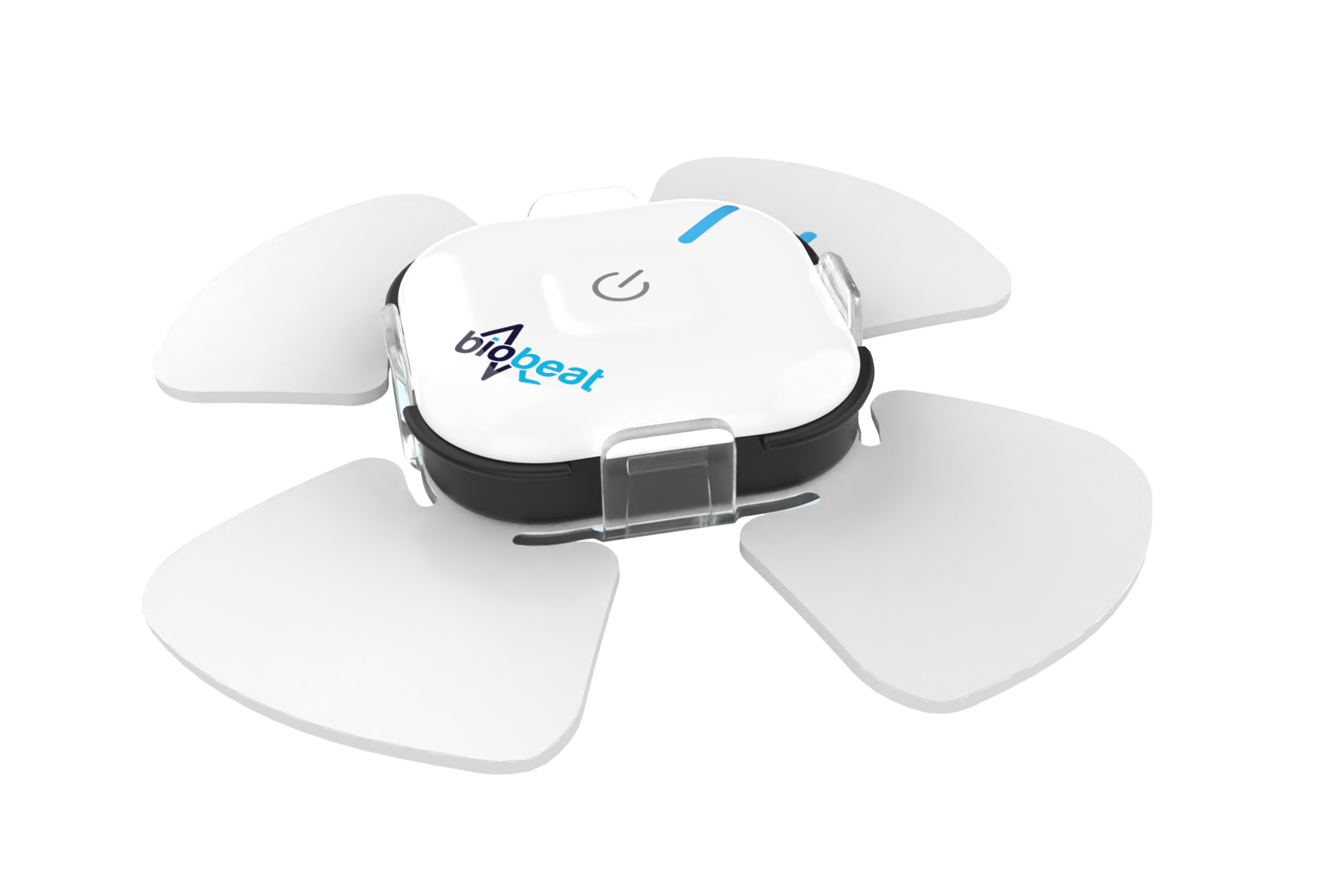
Biobeat’s cuffless ABPM offers an opportunity to easily provide an accurate, disposable diagnostic device at scale.
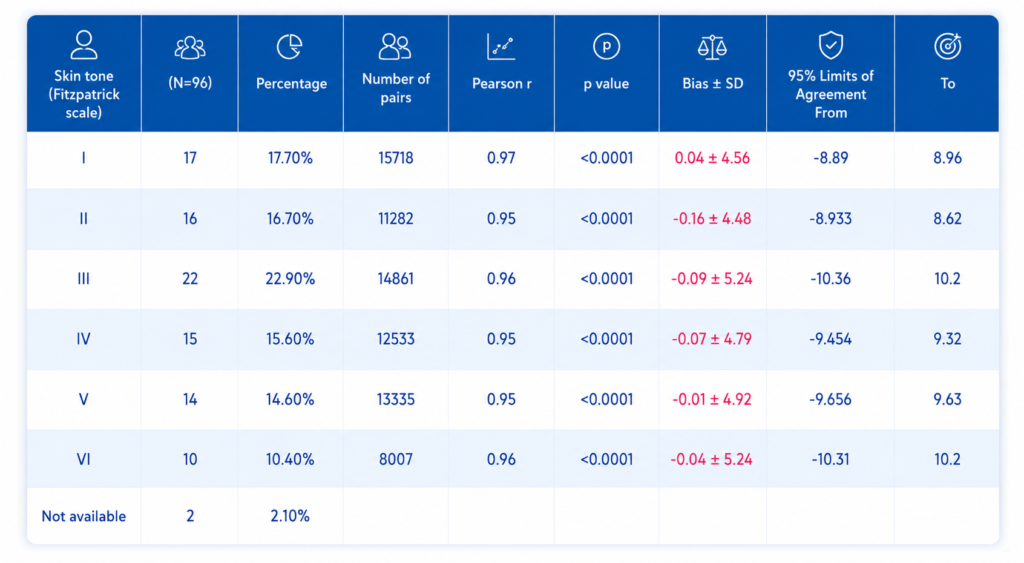
In a recent Mayo Clinic validation study published in the Journal of Human Hypertension, Biobeat’s technology was validated against the standard invasive arterial catheter in a diverse patient population:
- 96 patients, including representation across all Fitzpatrick skin types (I–VI)
- Real-world clinical characteristics, including hypertension, ischemic heart disease and diabetes
Across all skin tone categories on the Fitzpatrick scale above, the Biobeat device demonstrated:
- Strong correlation with reference measurements
- Minimal bias
- Consistent accuracy, regardless of pigmentation
Evaluating Biobeat’s effectiveness across all skin tones
As awareness grows around health disparities among minorities, as well as performance disparities in certain medical technologies, clinicians are right to wonder whether diagnostic tools work equally well for all patients.
Unlike pulse oximeters that underperform on darker skin tones, Biobeat’s photoplethysmography (PPG)-based cuffless chest patch accurately measures blood pressure for all skin types.
With Biobeat, there’s no risk of even subtle measurement gaps contributing to diagnostic disparities. This equitable diagnosis is the starting point for more equitable hypertension treatment across all populations.
Why validation across skin tones matters in blood pressure monitoring devices
Accurate measurement is the foundation of effective hypertension management. When blood pressure is misclassified, patients may be overtreated, undertreated or missed entirely.
Offering every patient in your practice the ability to capture their real-world blood pressure, including at night, can help more people with hypertension access treatment and prevent others from being overmedicated due to misdiagnosis.
Across all populations, Biobeat’s cuffless, semi-continuous monitoring addresses several limitations of traditional approaches:
- Enables 24-hour data collection without disrupting patient behavior
- Improves patient adherence by eliminating discomfort from repeated cuff inflation
- Disposable design provides scalable access to the gold standard of blood pressure measurement
Equitable measurement is foundational to equitable care
Biobeat’s accurate, scalable and patient-friendly solution is an opportunity to close the gap among minority populations and address hypertension rates as a whole. It’s a game-changing technology that reduces friction in monitoring while maintaining clinical rigor. With Biobeat, every hypertension center and cardiology practice in the U.S. can play a critical role in expanding equitable access to high-quality hypertension care.
See how cuffless, 24-hour monitoring can improve diagnostic confidence across all patient populations. Click here to request a Biobeat demo.
References
- Whelton, P. K., et al. (2022). Hypertension pharmacological treatment in adults: A world health organization guideline executive summary. Hypertension. https://www.ahajournals.org/doi/10.1161/HYPERTENSIONAHA.121.18192
- Juraschek, S. P., et al. (2024). Orthostatic hypotension in adults with hypertension: A scientific statement from the American Heart Association. Hypertension. https://www.ahajournals.org/doi/10.1161/HYPERTENSIONAHA.121.17570
- Centers for Disease Control and Prevention (CDC). (2024). Hypertension prevalence and control – United States, 2023. MMWR. https://www.cdc.gov/mmwr/volumes/73/wr/mm7348a5.htm
- American Heart Association. (n.d.). High blood pressure among Black adults. https://www.heart.org/en/health-topics/high-blood-pressure/know-your-risk-factors-for-high-blood-pressure/high-blood-pressure-among-black-adults
- U.S. Department of Health and Human Services, Office of Minority Health. (n.d.). Hypertension and Black/African Americans. https://minorityhealth.hhs.gov/hypertension-and-blackafrican-americans