From access to accuracy, hypertension diagnosis and treatment must evolve
Under the 2025 ACC/AHA new guidelines, nearly half of U.S. adults (48.1%, 119.9 million) now meet criteria for hypertension of over 130/80. It’s a sobering statistic for cardiologists and physicians, especially as only 1 in 4 adults with high blood pressure has their blood pressure under control (22.5%, 27.0 million). Eleven million Americans aren’t even aware their blood pressure is too high.
Despite being a leading driver of cardiovascular disease, stroke, kidney failure and mortality, few patients have access to an accurate blood pressure measurement device. This makes diagnosing hypertension among the most significant problems in cardiovascular care.
Accurate 24-hour blood pressure measurement matters
Done correctly, ambulatory blood pressure monitoring (ABPM) captures real-world blood pressure behavior, including daytime variability and nocturnal patterns. Blood pressure, of course, fluctuates with activity, stress, sleep, mood, medication timing and daily behavior.
Nocturnal readings, especially, are essential to diagnosing hypertension. Night-time ABPM is six times more predictive of mortality than clinic systolic blood pressure, according to a 2023 Lancet observational cohort study in 59,124 patients.
Single readings — whether in the clinic or at home — fail to capture this complexity.
Despite knowing this, barriers to the standard cuff method of ABPM mean most physicians are diagnosing and treating hypertension based on in-office blood pressure readings.
Why standard ABPM cuffs aren’t adequate
According to ACC/AHA hypertension guidelines, cuff-based 24-hour ABPM is the reference standard for out-of-office blood pressure assessment, providing clinically meaningful daytime, nighttime, and 24-hour averages that cannot be obtained from office readings alone.
However, in practice, this gold standard for measuring blood pressure over 24 hours with cuff-based ABPM often falls short. Even as hypertension prevalence has grown, the gap between what guidelines recommend and what practices can realistically deliver has widened.
Limited access
Everyone, from a typical cardiology practice to an academic medical center, lacks enough ABPM cuffs to diagnose and monitor the patients who need them. For those patients who do manage to access an ABPM cuff, each test requires the following:
- In-office fitting
- Patient education
- Device return
- Data download
- Clinician review
- Device cleaning
- Redeployment
These operational demands are burdensome for patients and clinic staff alike.
Patient compliance
Cuff-based ABPM requires repeated arm inflation every 15 to 30 minutes over a full day and night. For many patients, this is uncomfortable at best and intolerable at worst –– especially overnight. It’s not unusual for patients to remove the device entirely while sleeping.
Cuff accuracy
Patients often change their behavior during a measurement by tensing, changing their breathing or relaxing their arm. The adaptations are minor, but they affect the reading. The Lancet study cited above found a rise in systolic and diastolic blood pressures when the cuff inflated during self-measurement.
Together, these factors result in incomplete datasets for what’s considered the gold standard of measuring blood pressure. For a condition that affects nearly half the adult population, improving hypertension diagnosis and treatment requires a scalable diagnostic tool.
Hypertension care needs a new diagnostic tool for ABPM
Imagine what diagnosing America’s “silent killer” would look like if every patient who needed a 24-hour blood pressure monitor test could access a simple, comfortable device. Biobeat was designed to preserve the clinical rigor of ABPM while removing the barriers that limit its real-world effectiveness.
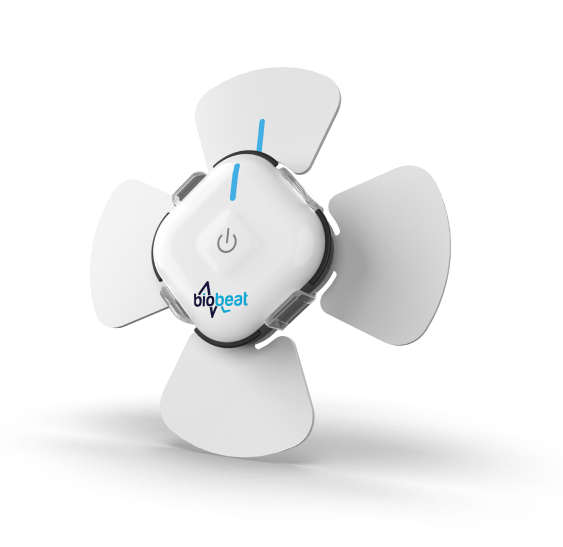
Biobeat’s FDA-cleared, medical-grade wearable patch enables continuous, cuffless blood pressure monitoring over 24 hours. There’s no repeated inflation, noise or sleep disruption.
- Improves adherance: By eliminating the arm cuff, Biobeat reduces discomfort and improves patient adherence –– particularly overnight.
- Offers patient convenience: The device can be picked up at the office and disposed after one use, making it significantly more convenient for patients.
- Automates results: Biobeat is connected to an application that automatically delivers detailed, clear results to the prescribing clinicians after 24 hours.
Biobeat enables every practice to offer 24-hour remote patient monitoring to patients who need it at scale. It’s a game-changer for diagnosing and treating hypertension.
A cuffless 24-hour blood pressure device with clinical accuracy
In research studies, Biobeat has been validated for accuracy against oscillometric cuffs, as well as against invasive arterial lines used in critical care.
The following are results from some recent validation studies:
Comparing Biobeat to arterial line monitoring in ICU patients
In a study conducted in post–cardiac surgery patients and published in the Journal of Hypertension in 2025, the Biobeat cuffless device was worn concurrently with intra-arterial blood pressure monitoring. More than 3.5 million data points were collected over 300+ hours of monitoring.
For 24-hour and daytime/nighttime averages, the observed bias was approximately 0.3 mmHg, reinforcing confidence in average values.
(Click here to download the Journal of Hypertension study)
Accuracy across skin tones
In an observational study in Frontiers in Physiology, researchers compared blood pressure measurements from Biobeat with those from a standard cuff-based BP device in over 1,000 ambulatory participants, stratified by sex, BMI category and the full Fitzpatrick skin tone scale.
Across all subgroups, systolic and diastolic blood pressures measured by Biobeat showed high correlation with the cuff device and minimal average bias (generally <1 mmHg), indicating strong agreement.
(Click here to see the Frontiers in Physiology study)
Ambulatory comparison vs. traditional ABPM
In a study published in PLOS One in 2025, patients wore both Biobeat and a conventional cuff-based ABPM device for 24 hours. Biobeat delivered approximately 97 measurements without inflations, compared with fewer usable readings from cuff-based systems. This was particularly true at night.
When discrepancies occurred, this was more often attributable to cuff-related issues, such as movement, inflation-related BP elevation or signal loss.
(Click here to download the PLOS One study)
Improved workflow eases cuffless ABPM pathway adoption
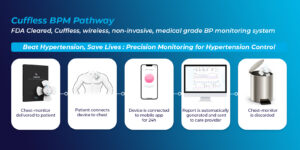
For nurses and office staff, Biobeat’s disposable design and application simplify clinical workflows. There’s no waitlist, no device turnover, no cleaning cycle and no need to upload blood pressure reading results.
Patients simply:
- Pick up the device at the office or have it delivered
- Download the app
- Watch a short video on how to apply the device to their chest
- Wear the patch while comfortably going about their normal daily activities
- Throw it out when they get a notice after 24 hours.
Finally, high-frequency measurements support robust daytime and nighttime averages, helping clinicians assess true blood pressure patterns, including nocturnal behavior, with greater confidence. Validation against gold-standard references reinforces trust in the data clinicians use to diagnose hypertension and guide treatment.
Biobeat doesn’t replace the gold standard of ABPM for diagnosing hypertension. It’s an improved method to get 24-hour ABPM results, making it practical and scalable –– while ensuring accuracy. For clinicians focused on improving diagnosis, treatment and long-term outcomes, the future of hypertension care depends on better diagnostic tools. Biobeat is the first cuffless blood pressure device to help get us there.
To schedule a demo of how Biobeat works or to learn more about how Biobeat’s cuffless BPM monitors can help improve HTN diagnostics and treatment, contact: info@bio-beat.com.
References:
- Centers for Disease Control and Prevention. Hypertension cascade: hypertension prevalence, treatment and control estimates among US adults aged 18 years and older applying the criteria from the American College of Cardiology and American Heart Association’s 2017 Hypertension Guideline—NHANES 2017–March 2020. https://millionhearts.hhs.gov/data-reports/hypertension-prevalence.html
- 2023 Lancet observational cohort study
- CDC
- 2017 Guideline for the Prevention, Detection, Evaluation, and Management of High Blood Pressure in Adults: A Report of the American College of Cardiology/American Heart Association Task Force on Clinical Practice Guidelines